
Roundtable Transcript
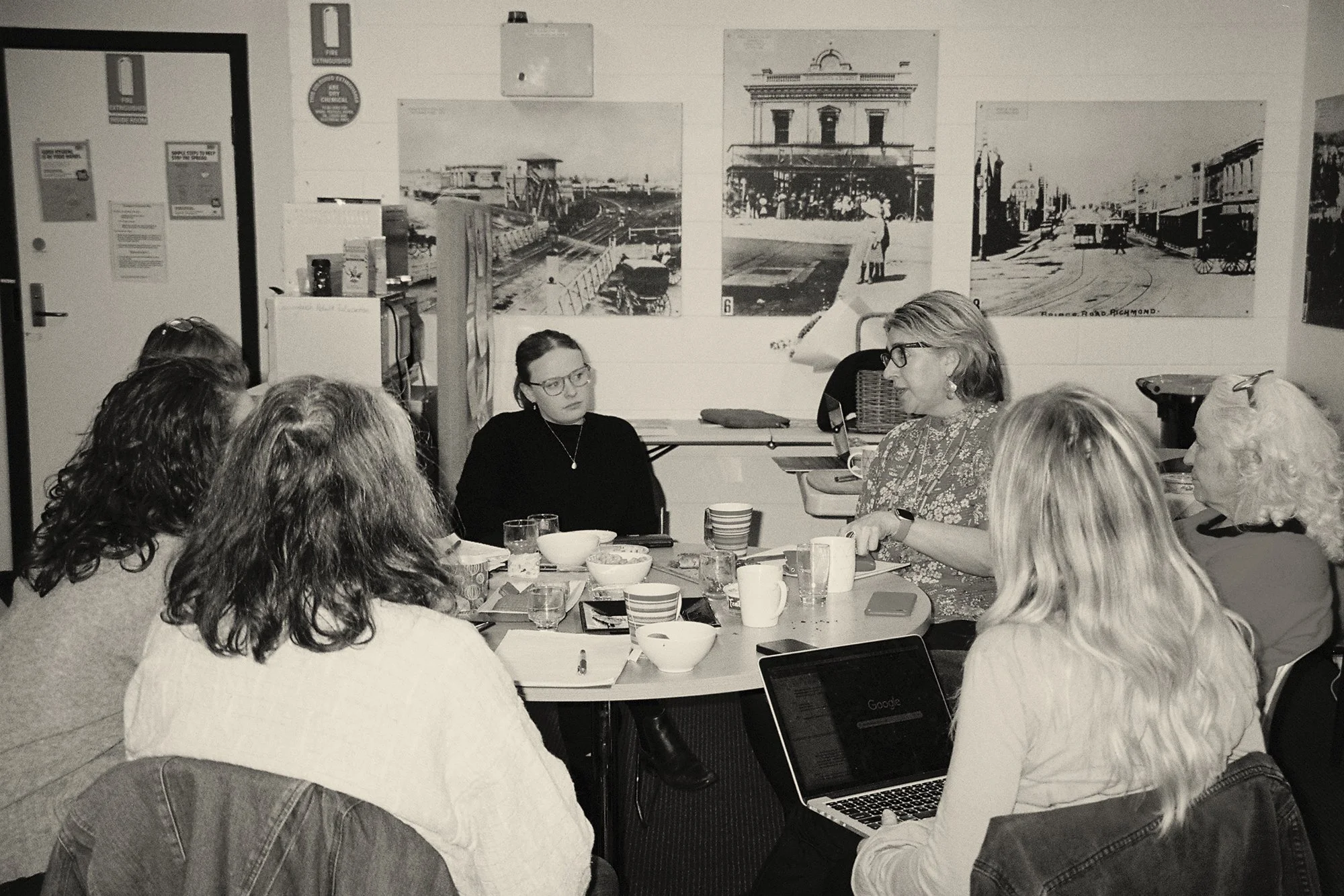
Roundtable participants gathered in the Women's Art Register communal space in Richmond.
EDITORIAL NOTES

Participants in speaking order:
[MR] Merren Ricketson
[KS] Kate Smith
[GH] Gail Harradine
[KG] Kirsty Gorter
[ET] Ellie Thomas
[NT] Nat Thomas
[ED] Emma Dacey

[SU] unidentified speaker
--- brief ellipsisMR: My name is Merren and I was first involved with the Register in the late 80s, early 90s. Education was a bit of a focus then, so I worked on promoting the slide kits, the five slide kits that we produced over a decade.
I had actually trained originally as an English and literature teacher, but always used art whenever I taught I ended up teaching sessionally at the National Gallery, using art always, obviously. And then I just had many, many other jobs through all that time working on Top Arts. I was an arts officer at ACCA. I was an arts officer at Glen Iris, always having, you know, about 15 or three jobs at once.
Then, about four years ago, just when lockdown started, Caroline [Phillips] rang up and said, “We’re going to make you and Liz McAloon life members.” (we had been sort of coordinators at the same time) “Are you interested?” I thought “Oh yes!”
So anyway, I went to the meeting on Zoom, and was so incredibly impressed with the women that were now at the Women’s Art Register. She said, “Oh, you better say something when we give you this award.” And I said, “Oh, no. It was all in the past.” Then I got so excited. I said “Oh, I have to say something!”
The next day, I was rung up by a couple of people and basically reeled back in, which has just been the most fabulous thing to happen.
KS: Yeah, I’m Kate Smith. I finished my degree last year in Creative Arts and did an internship with the Women’s Art Register during that. That’s how I was introduced. Then at the start of this year, I became part of the Committee.
GH: My name is Gail Harradine, and I am a Wotjobaluk, Jadawadjali, Djubagalk woman from the Wimmera and Mallee region of Victoria. It covers quite a bit of area from the Gariwerd [Grampians] National Park to the South Australian border to up near Ouyen so it’s quite a vast area. I would like to pay my respects to the Wurundjeri and wider Kulin nation mob where I work in Narrm.
My life has been a lot of moving parts that have branched off and, generally, my idea of feminism and supporting women and women’s rights is probably a little bit different, but only because of my background.
When I was young, I didn’t realise I was any different to people at school. I would go home to family (cousins and Aunties/Uncles) and people looked different. My Auntie, who was like my mother in the kinship system, had very frizzy hair and was very different looking but stunning. I started thinking, “Ok, we are different.” Then certain things happened to the family over time, the way we were treated. My brother on the footy field, people calling him a darkie, and then I realised it was a lot of layers to what was going on regionally. Connecting was hard at school. There were only two Aboriginal books in the library. I used to read a lot and loved stories of what other First Peoples mob were going through and this helped me understand cultural difference.
Education is such a huge thing and our time together (the Koorie Heritage Trust and the Women’s Art Register), has gone back to that, the 90s and the slide kit produced at that time that was ground-breaking. We got in contact again because I’m actually a Curatorial Manager at the Koorie Heritage Trust, so I’ve come back there to work and look after the collections of First Peoples art and culture, again from the 90s. I’m very much stuck in the 90s and not afraid to say it because I think we’ve got a long way to go with our young people, telling them about those that paved the way. It seems to be something that’s coming up with a lot of artists that have been established for quite some time—over decades. That’s why we researched and exhibited Seen and Unseen, an exhibition shown in 2021. We had a lovely partnership there and it’s sort of all connected.
I’ve completed eight years of uni study. My mum didn’t get to go to school past 13. My dad was a Victorian Railways train driver, initially working on the steam trains and eventually drove overland trains (diesel), so a lot of history there. He never distinguished between any of us kids. I’m surprised he didn’t think that I would play football! I am sure he would have supported it, as he was always there for me. Mum stayed home, a very caring mum, she didn’t work, but it was simply because that’s what she wanted at the time. She wouldn’t have done it if she didn’t want to.
There was a synergy there, you’d never really say there were any limitations. But, again, I’ve had limitations placed on me because of colonialism, the whole history and the hidden history, which is still very hidden prejudice that erupts regularly. We’re out there all the time telling people, yet there’s all these terrible things you see on social media. Everything’s still happening and there’s a long, long way to go. I think working together with places like the Women’s Art Register is really important.
I also just completed the residency for Seventh Gallery and the Women’s Art Register. Out of that, hopefully, I will get into a PhD at RMIT based on the concepts I worked on with experimental images and printmaking.
When I look back at the 90s, I wasn’t even offered an Aboriginal cadetship in Victoria, and it was hard to get a foot in the door at galleries, museums. I had to go to the National Museum of Australia in Canberra, a huge time for me. Sometimes you think things haven’t changed, but they have. Back then, people were scared of losing their jobs with First Peoples coming in, because it was such a niche sort of area for a museum career. I started at the Trust in the 90s because we were based at the Museum and then moved out of there to head home and have my family, so things have changed but not fast enough in many ways.
MR: You and your brother are custodians of your land, aren’t you?
GH: Well, my mum’s 87 now and a bit of a quiet achiever, still very active with her wisdom and guidance. My dad passed in 2010 and that was a pretty devastating time for my older brothers and all of us, and that has really made an impact on our family (lateral violence and a traumatised history where we come from). But we’re trying to work towards another reunion with the family because we have people all over, like any Aboriginal family, and a lot of other families. We still are encouraging people back that don’t know much about the family. Part of this will be in relation to my PhD work in examining women and ceremony.
A lot of our Stolen Generations and the families are broken up. That’s been happening for a while, but that’s still out there. It is a really serious matter and there is a redress situation scheme happening, but it’s still impacted on people. The trauma, it’s there, even with myself. I have to push myself to do things sometimes because of that trauma.
I found that In doing the residency, it was good for me to actually think about where I wanted to situate myself in terms of history and family history, and about bringing that all into my art practice. Often we’re all doing that around the kitchen table, because we don’t have a studio, and having that studio at Seventh Gallery recently was just awesome in conjunction with W.A.R. Just to be able to sit in there and think about things and spread out, when no one was there out of the gallery, thinking about a bigger picture when I’ve done a lot of smaller work. So then I was thinking “Oh gosh. This Is quite big. and more of a visual concept.”
I’ve been influenced by coming in here [to the Women’s Art Register]. Thanks to everyone for helping. It all filtered into the work. Now they’re having a whole First Peoples group exhibition schedule.
These sorts of opportunities are really important and we can’t just have one-off things. We’ve got to keep working on things because we’ve got a history of one-off things. My whole career has been one-off jobs for a year, which set me back. I can remember my boss saying to me, “Why did you want this job?” when I went for the Koorie Heritage Curatorial Manager. Because I moved back to Melbourne specifically to spend three months at Births, Deaths and Marriages and intended to go home again to Country. I basically said, “My brilliant career”, but then, “my career went bung” which relates to Miles Franklin’s works. I realised I had gone off tangent career-wise and did not achieve because I could not get through these barriers. Teaching, for example. I’m provisional, but I just can’t get over the threshold for registration, because it was a while between doing studies, I might have to do like a four-week block in a school (with requirements from the Vic Institute of Teaching). It’s just things like that that are insurmountable sometimes with Koorie mob, let alone everyone else. It just makes you realise there’s a lot more support needed for us all, that we can fall down pretty easily if we don’t have it. Career is important, and having those opportunities. I have gone off on all these different career paths.
I went back home to the Land Council and the Curatorial Cultural Heritage and that was pretty traumatic. It took 10 years to get an apology from the organisation, for a lot of trauma. And yeah, working through that whole “What does Native Title mean?”, “Why is the government still so fully involved in dictating who we are again?”
Now I’ve got back into creating, which is my first love, I’ve realised. As well as trying to work on my own art practice, it makes you realise that we’ve got all these different things coming in. How do we translate them into something we’re happy with and that makes us fulfilled? We’re all looking for that in many ways, doesn’t matter who we are or our identity or race or anything.
KG: I had a pretty easy life next to you. I did art school and then dropped out and hitch-hiked around Australia and then did art. After a couple of days of being an artist, I realised I had to live. So then I got my teacher degree, which was basically a year. It was mainly going and teaching in schools and stuff. I was teaching art, craft in high schools for 13 years. In that time, I popped out two. I realised that I was coming home from high school and talking to them the way I talked to my students.
Then I got offered a year secondment at Melbourne College of Textiles. After seven years, my school said, “Are you coming back?” RMIT had, by that time, eaten up Melbourne College of Textiles, and RMIT said “We want you to stay”, and I said, “Only if you’re giving me all my terms and conditions.” They did. I stuck there for the rest of my working life, up until six months into COVID, teaching in the School of Fashion and Textiles, and yeah, working in those areas.
I was a single parent somewhere along the line as well, so bringing up children and working. I was involved in all the unions, from the student union to the teachers’ union, depending on which union I was involved in, in which place I was teaching. In my last 12 years, I was President of the AU sub-branch at RMIT; also doing my own artwork on and off around children, jobs, and all those sorts of things. But I think I’ve been very lucky in my life.
When I was teaching, Sandy Kirby, who was one of our major people here [at the Register] was my history lecturer—it was extremely wonderful—and talked a lot about the Women’s Art Register and I joined W.A.R. in 1982. It was only where I couldn’t balance two children and driving from Coolaroo to come into the meetings—I think it was actually 1996—I had to continue being with W.A.R., but basically leave the committee because I just couldn’t do the juggle anymore.
Like Merren, for W.A.R’s 40th birthday, I was invited to submit work. So I did. It was at the Women’s Hospital. So that’s how I got back into W.A.R. They kept inviting me to other things.
When I decided I was going to retire, I thought, “Well, what have I enjoyed doing in my life?” and I remembered being involved with W.A.R., so I reconnected and, God help me, Merren was here. So it’s been an absolute delight to come in and meet everybody. It’s just been brilliant.
ET: I’m Ellie Thomas. I am currently the Secretary here at W.A.R., and I started that this year. I’ve been involved with the W.A.R. since moving back to Melbourne in 2022. I was looking for a community. What a great opportunity it’s been, especially when you’re new to a place and you don’t know anyone.
I have a background in lots of things, but I studied psychology and art history together, and I was really unsure whether they would kind of coalesce. When I came here, I came here to study the Master in Cultural Materials Conservation and couldn’t avoid thinking about how the focus on the object removes this idea of the feeling. Feeling the life force within materials that don’t have to be material. So I kind of engage my feminist psychology practice to consider how being critical of your own practice, you could apply that to conservation to be critical about what are we doing when we only look at the object, or the dispossession of something, and we strip it of its history.
We are these agents that operate to ignore histories, to just to treat materials. Of course, it’s not always the case, but I just really like the idea of how we can work as conservators with artists to continue to honour the changes to materials, to legacies, and you know, you sell an artwork or an artwork gets acquired, but your ideas still exist and they change and they grow. I just love thinking about that kind of thing, and how institutions are so against that. Like, how can we facilitate changing artworks after they’re acquired? I really think that it’s a really nice way to consider how we can work together to change. So that’s my current interest.
I work at the University of Melbourne with Emma, and I also work at a new museum that opened on Friday in Hawthorn.
NT: My name is Natalie Thomas. I grew up in Brisbane to a single mum, and I’ve got one little brother. I trained straight out of high school as a Home Economics and English teacher.
I was taught Home Economics by Gordon Bennett’s widow, Leanne Bennett, which is just a strange part of my History.
I went to London and lived in the 90s, returned to Australia, settled in Melbourne, went to the Victorian College of the Arts and studied sculpture. Whilst at university, I started working collaboratively with my best friend, Ali, and we became Nat & Ali.
We were loud and made a variety of different artworks—some of them performances –and took on some Riot grrl strategies, I guess, advocating for change and addressing some of the sexism that we’ve sort of grown up with, in and around our artwork.
Then I got pregnant in 2004. I had a daughter, Maxine. Nat & Ali finished. And then I’ve continued making art in variety of different ways.
At one point, my practice looked at words. I started writing more and more. I enjoy writing. At the moment, I’m painting. and in the same way that I sort of taught myself to write. I’m enjoying working in a new medium.
I was asked to speak at a W.A.R. forum upstairs in the [Richmond Library] theatre and as part of that they had a—I can’t even remember what year—a little market and I made some posters. Some friends had given me beautiful paper and I just rolled it out and wrote “Listen, thanks, Lucy Lippard.” Just some slogan works. And I had those for sale and that was the start of me painting, I guess. And I’ve spoken with Caroline Phillips, on different panels and things over the years. At the moment. I’m very interested in the life and career of Erica McGilchrist, one of the founders, the original founders, of the Women’s Art Register.
And I guess my art project—I’m interested in how culture silences some and not others, and systemically works to maintain patriarchy and, I guess, white supremacy. Tomorrow night is an art auction at Leonard Joel and it’s focused on female artists. I’ve been attending art auctions at Deutscher and Hackett and Leonard Joel for the last couple of years.
The last auction I went to at Leonard Joel was for posh handbags. Some of the sales for second hand handbags, like Birkins, will be more than for the artworks tomorrow night. I’m interested in money as a system of control, you know, the financial subjugation of some people and ideas in and around value. What society values andmoney is, Lots of people stop practising art because they can’t afford to continue, doing little bits of this and little bits of that and, all of a sudden, you don’t have the energy to drink. Yet lots of my male peers through art school have managed.
ET: It’s funny as well, isn’t it? Like those Birkin bags are likely made by women but no one’s buying women’s art as a market.
NT: Yeah. Because now when I go to art schools—and it’s expensive to study art now—I look around at the students, and I’m like “I hope you can afford to pay these HECS debts because of the over-investment of women into that profession”. It worries me.
ET: Yeah, it’s kind of—not to go too far off track—but it’s like what we were saying about how when you know you go into a space that there is no outcome. And there’s no support at the other end of that. But your expectations because you’ve invested so much of yourself into that, that then when you walk out the other end, and no one is there for you. It’s just crushing. You have to figure out the quick way to pivot, otherwise you know you deal with all sorts of issues of self-worth and lack of self-worth, and how you continue to sustain something beyond that is so challenging.
ED: I’m Emma Dacey. I went to art school straight out of high school. That was wonderful, but I never left with any expectation of myself that I would be an artist because that was for people with independent income and same as you, I’ve seen, I’ve watched, the men that I’ve studied with go on to have successful careers and women as well, but they have their parents.
I went straight into working for a dealer gallery, so I saw that’s no way for making money. That was not a negative thing. I loved working with the artists. I was terrible at selling art.
From there, I got an opportunity to work with an artist in New Zealand, and kind of worked with her entire body of work. She was in the late stages of her career, still practising, but her very early stuff from, the 60s and the 70s was very iconic and very highly valued in New Zealand. I was able to work with her entire body of work and I loved that. I ended up kind of doing digitisation and providing access to her work, and from there I realised. this was a thing I could possibly do generally, and that’s when I got introduced to conservation as well, at the National Library. They had an incredible conservation lab. I did some Museum Studies, but it wasn’t quite as hands on with materials as I wanted to be, because I still have that background
from art school and i am very interested in materials, as well as the person and the decisions made. And creating art, and then creating archives.
I moved to Melbourne to do the Conservation degree, to finish it 18 months ago, and it was around that time that I got involved with W.A.R. because I was reading about Leaving Your Legacy. I got so excited about what that represented and how much that aligned with my experience working with this one photographer and her body of work, and how useful that would have been for her and people of her kind of culture and experience.
She was so lucky in that she had a dealer gallery that advocated for her, and he was really good at promoting her work and, you know, all this success and later in her life, but not everybody gets that.
[SU]: Let me ask what her name was. That’s probably Ans.
ED: She is a Dutch woman who lived in New Zealand from the early 60s, a documentary-style photographer who documented lots of people’s lives and lots of important moments in New Zealand history.
[SU]: Yep.
ED: And not always a straightforward human being, very complex and problematic in some ways. Some of the documentation she did of Maori people and their lives have been challenged by the Maori people. Yet, you know it’s, an incredible record and highly valuable to them, and they’re trying to take a bit more ownership of it now. They’re actively seeking people to identify people in the photographs, and that’s a really interesting project.
[SU]: And probably very fraught as well.
ED: Yeah. So she hasn’t always been celebrated for her work, and socially, and she absolutely recognises her treatments and then also understand that she was an outsider, documenting community that wasn’t hers. Umm. So yeah, never getting all those new answers is exciting.
And I work in an archive for the Royal Children’s Hospital, which again has got a problematic history. So, thinking about how a place can be absolutely celebrated, but also that we recognise the things that have occurred under the means of that hospital that shouldn’t be celebrated. How are they acknowledged? And how do people deal with grief and how it’s represented?
Yeah. So, I’m very, very interested in photography, and the choices people make in taking photographs, but then also what that looks like once it’s become just an agglomeration. So what they represent as individual photographs, but then also what they represent as a collection you have. Because she probably wouldn’t have sought permission to take those photographs, or future photos. And she had relationships with people, and they invited her to the marae, say.
But then, later on in life, when she’s selling prints for six grand. What does that mean for the subjects and the photographs? And say they weren’t identified?
---
GH: That lack of documentation follows us everywhere really. I mean, in our world, it’s huge, and you always do have some sort of material or cultural belongings that may not have all the information that you’d like, unfortunately, and it makes you think about your own legacy—getting back to legacy—and the people around you, because it’s just not happening that well. I mean, it’s great to have these sorts of things that might accelerate that way of thinking, because yeah, you know, photos have had such a huge value.
I worked in the museum originally and you’d see the photos. And when I see them now, I go “OH. Remember that?!” It takes me straight back. I got the direct route to the collection, you know, when I see them, because I know, “Oh that’s the Yorta Yorta mob or other families in very stunning images”.
And beautiful photos that were amassed, you know, and you know things that we have often in collections. We’re still trying to find out who the people are at times. Very similar to what you were saying. So a big issue. Like, storage of things for artists and collecting information.
MR: I wondered, Gail, if we had the correct consultation in Completing the Picture. We had the works by Leah King Smith, where she’d taken studio photographs, nineteenth-century studio photographs. She had then merged them with her own photography, and her idea was that she was inserting them back into the environment. So there’s all sorts of things about that as well. But they weren’t named, those people, and so that’s become highly, contested work hasn’t it?
GH: I think so. I mean, I haven’t had any direct liaison with that one. Just generally, I only use photos of myself of my own family. And, you know, sometimes if people don’t know me, they go “Well, why are you using those photos?”
MR: Yeah.
GH: It’s like, well, they’re my family, my great aunt or, you know. My dad actually had them in a cardboard box. I think there was a roving curator role at the Museum a few years ago now, and the lady that used to be in the position was my mentor at the Museum in Canberra, she was in that role for a while and such a great role in visiting communities. And another fellow, Norm used to be in that role. Out of that program, they used to go around to community mob and give them archival boxes (for photos). And they were Great Aunt Clara’s photos. So they go way back, but I just feel it’s important to connect with the photos and talk to my mum all the time about it and keep her up-to-date because she’s the one looking after them, since my dad passed in 2010.
I mean, I would never do anything that was disrespectful with the photos, but what I do is I use my own imagery like printmaking and watercolours, anything, you know, that I feel links with it and experiment with it a bit. I make sure I tell people they’re my family photos, because I wouldn’t use anything that wasn’t mine. I think it’s problematic otherwise.
You have to go back to the community mob and the Elders and work with them on any projects. I think that’s sort of working pretty well generally, in our family. And, you know, you’ve got like funding bodies now that are a bit more onto it with cultural protocols and ethics.
I’ve been involved with Creative Vic with the First Peoples Direction Circle (First Peoples First) and I’ve been on assessment panels and questioned certain applications because of the lack of connections with the community. Just in terms of trying to get the right balance, because it’s also about people’s money and govt money, it’s important to be fair to everyone with funding submissions because everyone struggles there as well, as we said. It’s so competitive.
You know, we have to work to survive. I would have liked to have done more with my career. But you know, that’s just the way things go and you just gotta work around things and think “Well, what? What can I do next that would make me happy?” And I don’t wanna make the government happy or make anyone else happy. I wanna make myself happy. It’s about wellbeing. It’s this drive, isn’t it? What you do have to say is so well reflected in our Cultural Storytelling and Creation Stories and I think that’s what people forget in the equation of you. What are the big subjects at school? IT should be art, language and culture based for the region.
Our Art section at the old Uni TAFE at Horsham has been taken up by Engineering. You know, the art they had, they had a Koorie design course years ago, and they made screen printed games based on Creation stories as my brother Stuart made one and it was so innovative.
[SU]: Wow.
GH: I tried to pitch them to some organisation that sold work like that, but no one was interested. Great ideas. That’s, you know, massive, I thought, and great lecturers and stuff. It all went into the ether and it’s a bit sad because you think of all the struggles that people are going through, especially regionally. We’re losing our TAFES and everything. That’s a whole ’nother story. That schools closing down.
I just feel like the access to wellbeing programs, we have to fight for all the time. But then the whole Engineering section can be put into the old Art section. So I guess there’s these staple sort of careers like nursing and engineering and everything, but art’s always been a wonderful place for people that have felt a bit like an outsider, and bringing people together to learn about the bigger picture of their world.
MR: You know, we’re talking about art being a career for the twenty-first century with, you know, problem solving, thinking about the challenges of the world. It’s interesting, isn’t it? They wanted to fund that game, you know, take it to a private concern, but didn’t fund it themselves. Didn’t have the money to fund it themselves.
I was just driving here listening about NICA, the circus high school. So that has been closed and it’s been given to the College of the Arts. So now it’s gonna cost $40,000 or whatever it is to attend. I mean, what you were bringing up then was class and, you know, people who say there’s no class system. You know you’re talking about wealthy parents. Privilege. Umm, you know, this is the thing that we’re all affected by. You’re also demonstrating what we’ve been talking about, having to have many jobs and many roles carer, curator.
GH: Yeah, yeah. And, you know, having a family shouldn’t stop us either. And then, that’s all those layers. At the end of the day, you know, we want to be paid the same, and for what we do, and even that seems to be still a bit of a challenge. I did notice that and it’s interesting, you know, thinking about all those sort of things. I mean, just looking at my partner’s career and mine, so totally different. We have our children, but we’ve also got uncles and aunties and other extended family to look after and it’s not easy juggling work, study and creative opportunities. That’s what we’re doing. We’re caring for other people and trying to stay staunch.
KG: Yeah. The roles I took on, even though I was paid for them as a teacher and a union delegate, that’s all bloody caring.
[SU]: Yeah, so much worse. You don’t just clock off at the end of the day and forget about those people.
GH: And you’re trying to keep your own self-esteem up and everything at the same time. That’s a hard bit, I find.
[SU]: Yeah.
GH: Because I struggle a bit, I’m so emotional, you know, and I sort of draw on my art to keep me balanced and then, if I don’t have that balance, I’m just going through the motions of getting to this place so I can do that, and then you’re tired, and then you’re ”Oh. I feel like I’ve come to the end of the day there. I’ll start again tomorrow.”
You know, you always gotta boost yourself a bit. It’s a challenge. I just seem to have gone from job to job and you stand up for yourself, and you speak up, and I’ve just been trampled, by other women as well. It’s nothing to do with just men or something.
It’s that lack of understanding. They’ve got an outcome that they want, and if I’m saying “Oh, maybe we should go this way because that would be how the Community would probably think about that” and then they just walk over the top of that. That’s the job I don’t really wanna be in.
Well, you speak up and you’re treated as if you shouldn’t have spoken up, even though you’re meant to be the Community Liaison person, you know, and you’re the one person in the office. We gotta get away from all that, and that’s why we’re trying to get more people in the workplace, be a bit more strategic.
I noticed with my daughter. There’s an organisation called Career Trackers. So, what they do is they work with Indigenous young mob, and team up with people, and they have mentors in the workplace and different things. That seems to work pretty well, especially for my daughter. But I never had that, you know. I kept thinking of things—not that it’s about me—but you know older generations (lack of opportunities).
KG: We know that things keep coming back and we get the backlash and stuff, but so good you can actually see some things which are for your daughter.
GH: Yeah, there are some things that appear to me to be working well, but we just got to get the right people, that aren’t going to just walk all over people and put you in the job as a token as they call it, because that just totally wrecks people’s ways of looking at themselves. We’ve gotta get the Community more opportunities because I’ll go back to the Community, but then my way of thinking is totally different sometimes because I’ve had different experiences.
I’ve got to work around a lot of the cultural safety stuff—or lack of cultural safety (lateral violence and ways to combat this)—and then if you leave home, it’s not really appreciated that much. So it’s hard because I’ve been away and I’m living off-Country. Now and again, people look at you in a different way in the Community. Sometimes it’s just working through all that.
MR: Yeah, and you know, just also getting back to your point Nat, which Is fascinating, about the value and control, and no-one’s felt that more than those communities in regards to resources and not having a say, and it’s always a lack of resources, whether it’s women’s health, mental health, Indigenous health. This is why the grants are so competitive as well.
Ellie used the example that the college is putting out 50 conservators a year. Fifty conservators are graduating and there’s only one job.
ET: Yeah, there’s only one job a semester.
MR: Wow.
[SU]: Knowing there are other people that are also still waiting for a job that are maybe two years ahead. But there are people from, you know, other parts. Everyone intersects onto these very few opportunities just across the board.
So then you’re exhausted and stretched, trying to become the most brilliant person you can be just to have the opportunity presented. And you know, you just have to be this overachiever to even feel like you deserve a seat at the table.
GH: Such an important area, conservation. There is an Indigenous conservator at the NGV. So I had a bit of a chat to them a while back, that whole thing about the trust too is bringing people in to learn about Aboriginal culture and you know, we did have volunteers as part of studying and placements. That will continue hopefully, and it’s a great opportunity because, you know, it’s a real meeting of minds going through a collection.
When you look back, there was no one even valuing Indigenous material from Vic. because everyone with the white art market was inundated with everything dot art, which is beautiful, of course, in its own way in representing complex ceremony and cultural elements. But me being a passionate Victorian First Peoples, I just feel really strongly that I connect with the Koorie Heritage Trust.
I am interested in work from everywhere else, and I’ve been around to different communities, but just keep coming back to working with Victorian cultural belongings.
MR: And can the Koorie Heritage Trust have much impact on the acquisition policies of the NGV? Because I’m assuming they get quite a lot of money from donors and things. Every time you go in there, there’s new work. It’s quite a big institution. Do have a really strong connection with the NGV?
GH: Yes. I think there are great ways of communicating between the organisations, especially in being part of the Fed Square complex. There are linkages with exhibitions and interest in artworks shown and this does feed back into …
[SU]: So you hope that that works?
GH: And I mean, there’s a lot of conversations that go on. Look, with a lot of older people too out there, it is hard to change their minds on things. We were basically labelled as savages previously, and primitive, and all that sort of thing. And you know you’re coming from that and no one understood even about caring for Country. It was just wandering or, you know, nomadic. When it was about seasonal caring for Country, and skill involved in actually living off Country was incredible—it still is today—many people are working very hard to keep that going.
Just having to even work on our own languages. My great, great grandparents weren’t allowed to speak language or practise culture at Ebenezer Mission at Antwerp where my family were forced onto.
It was only a few hundred people left in Victoria after invasion and massacres. We’ve all come from that. There is transgenerational trauma that happens. Especially when you know there’s that push back on actually listening to people’s own voices.
It’s slowly changing of course, and that really helps. And I think there’s so much happening out there, even fashion and textiles, the Blak Design program’s going great. There’s the RMIT Brunswick campus support for fashion and textiles with the current cohort, Dr Christian Thompson is a tutor. Lovely people, too. It’s a great setup out there.
The KHT’s Blak Design program actually came out of the NGV involvement too, and ideas from the NGV working with the KHT. I mean, obviously we pushed it, and got funded, but it’s just a small little seed of an idea. It was great to work with Simone LeAmon from NGV and from the Design and Architecture section.
The first program that was ever done in jewellery was Shiny Shiny Blak Bling, which was a funded Australia Council one, which I was involved in with other people. We learnt from Peter Eccles, a really lovely silversmith and we are very proud of that program from the 2000s.
The Blak Design program is with nine or 10 participants a year and first, second year jewellery going into ceramics and then fashion and textiles. So, you know, trying different things, really.
I think it came out in discussions generally about how Cassie Leatham and Maree Clarke started doing production work and the innovative approach with such First Peoples work. That whole idea of production—that’s a whole other realm—which people are trying to get into more.
You can sell your artwork on all sorts of levels like markets, which many people do and do a wonderful job. Then there’s how you sell your work at that level. Well, we were fortunate to get one of the 3D necklaces in the KHT collection. I mean, it’s incredible. They’re amazing to look at and one’s kangaroo teeth and then there’s the gold one. I’s just beautiful, seeing those works. Their price is calculated on production and all sorts of different elements. It’s quite complicated.
As an artist, I struggle with pricing. I think others do too. To be fair to yourself and your time. The federal amendment—for the percentage I mean—it’s just so wonderful. I remember when Sonja Hodge and Maree Clarke were making little painted brooches. There was Kiah crafts from Mildura and that’s how it all started happening in the 90s. I did a recent little film for Fed Square and I had to pick a favourite piece. I thought I could pick Sonja’s as love the jewellery but ended up discussing Daryl Rose’s work because I love his work and hardly anyone sees it, and it’s from the 90s too. There is so many beautiful works in the KHT collection.
There’s a book called Living Aboriginal History of Victoria, Derek Fowell and Alick Jackomos. Andrew Jackomos’s dad, and Alick knew, I’m sure, everyone in Victoria—an amazing, man. Anyway, they went around and wrote this beautiful book. in that, Daryl Rose is talking about his work, and how Maree said to him, along the lines of, Oh. You should look at painting rock art designs from Gariwerd region because there’s all these different links of different groups around that area, and beautiful rock art. Eighty per cent of the rock art’s in Gariwerd and then you’ve got the two Black Ranges each side, and one’s got Bunjil’s shelter. The really important rock art like Bunjil in the human form and the Wilkurr—dingoes. So he’s got all those beautiful designs and it’s an amazing necklace. I had to describe it all and talk about it in this little film for social media for Fed Square.
Anyway, my sister-in-law, said “Daryl knows that you did that”. I said, “Oh, that’s good to know.” I thought he’d tell me off for talking about his work, so I didn’t get to tell him. Usually I do tell people, but that happened really quickly, and he was really nice about it. It’s just nice, all those little oral history stories behind the scenes, that we try to collect now, which weren’t collected probably that much previously.
I did have a very special Uncle come in one day on the collection tour. He was looking at this craft material that was there in one of the shelves saying “Yes, I paid their rent that week buying that, and I mean that.” Said it all.
[SU]: That’s cool.
GH: I mean, that’s how he thought about it. Apart from purchasing things at auction houses, I was thinking about him when you spoke about that. We get some of our materials from auction houses at work, selling off all their stuff. He had a cultural heritage inspector badge and he could go around and confiscate material. The old, old material.
We did see some in a shop window in Collins Street one day. This is when we were young, in the 90s and thinking “Oh my God, how can they do that? We ran back to get Uncle. Came back there with Uncle and they’d taken it out of the window.
[SU]: Oh.
GH: It was like clubs, old clubs, but it’s just an example of how it’s really personal material. So we started calling things cultural belongings because we had Peter Waples-Crowe come in and do a collection tour one day, and he spoke about cultural belongings. I always attribute that to him because it’s just a really nice way to say it, and because they’re not just clubs and stuff. They’re actually really, hugely personal and highly skilled pieces of work. That sort of skill takes a long time to learn, but that was the whole point of learning over your lifetime, as a Koorie person, and having that handed down through the family and the whole kinship. It’s all there for a reason.
Creation stories were the backbone of it all and ways of behaving. That’s always behind a lot of the work people are doing, and connections with animals and Country. But those little stories are really important to document, about anything that comes in. We try but, like anything, when there’s a lot going on, you’ve got to really push it.
We try to promote culture and art a lot and Fed Square’s a good opportunity to do that and work with people. We’ve had Myles [Russell-Cook] from the NGV come in and see works they’re really interested in. It might relate to an exhibition they’re having and really relate to their collecting policy.
He’s consultative. He’s got very consultative morals.
I’m on the strategic council there and other people are. A whole lot of people. It’s more of a checking-in and adding value, adding our ideas, like artists out there. Because the whole thing is, we’re so behind with our artists. There’s been a couple of retrospectives like the lovely, late Destiny Deacon and Maree Clark. But there’s a lot of our artists out there that haven’t had that recognition, that have been working over their whole lifetime.
MR: Have you been to the Koorie Heritage Trust?
[SU]: Yeah. I mean, it’s pretty extraordinary. The show that’s on now, is it still up? Karen Casey—Let’s Shake exhibition.
GH: Oh, Karen Casey. Yeah, and the Spirit of the Animals exhibition. Very different from each other, those two exhibitions. But we’re very pleased to have that donation from Karen’s son Daniel of her installation of plaster casts of squeezing the wet plaster in hands as a reconciliation marker as people get to know each other whilst the plaster sets.
MR: Because soon after Seen and Unseen, you lost Karen?
GH: Yeah, it was, it was. It was around that time. Makes you realise that time moves along very quickly in life.
MR: Do you know what we’re talking about? [to the other participants] Because we did a slide kit with 12 indigenous artists in 92. Then four years ago, the Koorie Heritage Trust came to us and said, completely out of the blue, “We want to revisit that exhibition”. Talk about artists that were also working at the time, It was the most extraordinary thing. So, 30 years later, this exhibition.
We had launched the education kit with an exhibition in the Access Gallery, and then those artists were back again.
GH: But the thing was that three of those artists had died in that time frame. Karen Casey was young. And there was one artist we couldn’t find much about. Sometimes I think I should be in a detective because it feels a bit like that sometimes. It’s a lot of research.
You can go into Seen and Unseen—I think it is there –and the lovely thing about it: there was the late Ellen Jose’s husband (Dr Joe Toscano) speaking on the film. That was really special because he spoke about how artists used to come to Melbourne from a Community or something, basically doing slave labour, work, out somewhere, and this is how it all worked with the galleries. So I thought that was really interesting, to have that brought out. He himself said Ellen used to go out and protest about it. It’s all in the film. That was really interesting.
Then we had Treahna Hamm as well. That was nice because it was around the lake, I think it was Yarrawonga way.
One series of Ellen’s work also talked about all the Indigenous soldiers who’d been in the unit and came back to nothing. They weren’t given tracts of land (Soldier Settlement), Aboriginal people weren’t eligible for them when they come back. My dad, volunteered for World War Two straight away, and yeah, he wouldn’t have been eligible. But my white grandfather was. That’s why they (my mum’s family) went to Red Cliffs, but the land they gave wasn’t very good. Well, they couldn’t survive. So yeah, it was a little bit problematic in that way, that’s for sure.
It’s an example of complete difference you know, and these people volunteered straight away from the Koorie community. My dad had his 21st up at Darwin and he was there when the bombings. He went to Borneo as well and he sent his money back to Great Aunt Clara.
Mum said he had a lot of respect because of his war service and because he had that great sportsmanship way about him. He was a good footballer and everything, and he went into bowls later on as an older man. He was able to fit in but it wasn’t easy at the same time.
I wonder what the rules were because other things happened too, such as the Vietnam Vets did not feel welcome to go to the RSL. It’s a pretty sort of white supremacist organisation in some ways, and yet there was incredible companionship. And a sense of this is where men were able to talk about their experiences. I don’t know whether I can mention names, but all I know is that he didn’t stand or didn’t clap or something when Bruce Ruxton was in town.
That’s all I remember, and that was a big stand for my dad. Yeah. He wasn’t out there, but he did have it, that quiet, chip away behind the scenes about him. I remember he was very adamant about that. Because there’s a lot of things said in that regard, with that man, that weren’t correct and I don’t think dad got really into RSL There again though, when he come back to Dimboola, one of the fellows offered to build a house for him, but he said. “No, no, no. I want a house, but I will get it build myself.” It’s just interesting, the family had a very strong work ethic.
I mean, gosh, I go to dancing now and stuff like that and I say who I am (Aboriginal) and one lady said “Oh, but you’re educated.” and you think “Oh God. Okay, I have to start from scratch.” Then another guy thinks it’s funny to say “Oh, but I’m paying. I’m a taxpayer. Paying for all you to sit on your bum or something”. Then he goes, “Do you work?” and I say, “Well, yes I do.” and he doesn’t know what to say to that. It’s like we’re starting from scratch here, aren’t we? It’s just really upsetting in one way. There’s a lot of ignorance out there, and nice people, but very ignorant about Indigenous stuff, for sure. We can’t rest on our laurels.
That’s the cost to society of media barons like Murdoch and the Packers. Racism. You can treat me as separate. You don’t really see me as Aboriginal, which some people do. At the end of the day, though, growing up with my family, I have a lot of knowledge and I am on the Emerging Elders and Elders Group for the Victorian Aboriginal Corporation for Language [VACL] as Wergaia language is very important to me.
It’s really important to me to help my mum as a Senior Elder and it’s no different looking at me or anyone else in my family. It’s really funny, though, that people can put you in different boxes, because you feel it from people, that it has to be about colour all the time, when I feel the family similarities between all of our mob. I see Australia and all the connections are really strong still and the knowledge is there, but everyone’s been trampled a bit due to colonialism and privilege.
KG: Well, I mean, that’s right. When we bring up the founders, the role of the media in regards to racism in this country, it’s just immense, because of the stranglehold they have over most media.
[SU]: Absolutely disgusting.
GH: I remember doing a talk for the local newspaper in Horsham, and they didn’t even know there were recommendations in the Deaths in Custody report as to the proper way for media to address things. I can still remember my friend, that I worked with from Palm Island saying she’s sick of seeing the articles on Palm Island. People just lying there on the grass with the alcohol around. They just have this certain stereotype that they keep going back to.
Yet there’s so many people I’ve come across, so many First peoples, because we’ve now got more pathways in unis and all the way through from education, from the start. We’ve got more support, Career Trackers, because without that, that’s a hard bit. It’s pretty hard to keep going if you’re away from family, which a lot of people are. That’s the hard bit. When I was up at Canberra for two years, I kept on travelling back home on the weekends. And going back away and that isolation feeling was pretty awful.
I wasn’t gonna say anything. It was a little bit scary, but I mean, it was a great area. The National Park and Canberra’s amazing, when you’re going around it. I guess I had a lot of knockbacks and things, in feeling part of the setting there.
KG: Sorry.
GH: Everyone does, I think.
MR: Absolutely.
GH: I think art just gets you through some sometimes, with all those sort of things. We’ve got so much to learn through art and about culture, and how we see ourselves. Because my family didn’t have a voice, you know, and somehow they got through. My great, great grandfather was doing bark canoe demonstrations in the 1930s at Antwerp and stuff, and I found an old photo in the least likely place back home.
MR: Wow.
GH: Just in an old stone cottage outside a very small town near Ebenezer Mission. It was my great great grandfather on a canoe, in the format of a box-camera-negative style and I took it to the Museum and got it printed. And it was him. Yeah, it’s just incredible. You can find something decades later.
I think there was a time when my dad was a little, little one, a little tacker, went too close to the bark canoe and he got told off and there were stories like that when I was growing up. But, you know, all that culture was still there, but they were too afraid to show it too much because you get the knockbacks.
One of my aunties was a nurse and she couldn’t say she was Aboriginal: she wouldn’t have got in to do nursing. Then you’ve got people that say, “Well. She should have stood up a bit more or something,” but you had no power. She ended up running a hospital. Fed the family and looked after others in the family. She went skydiving at 91. She was on the news but she, again, had a really sad history where her son was taken by the husband. There’s all these other layers to things that are really painful for people. She never got that connection with her son.
He’s passed now over, and we didn’t get to say goodbye to him during COVID times, it’s a bit sad too. So it’s all these little things that happen. We did try to get them together but it was very hard for her. I think she put up a bit of a wall to protect herself.
Her husband used to supply all the Clydesdales with the carriages for the old movies like, Sarah Dane and all those movies. Interesting history. There are photographs of this, some of it. She’s amazing and I sort of feel very connected to her. That’s where again I draw all of this history and the photos.
The two [people] that are in here [the photo shown] are my aunties on the different sides of the family. It was really lovely to see this image, Aunty Cath, she was a really tiny lady. I visited her one time before she passed and she said my hair was like my grandmother’s (Maria). Aunty Cath was very tiny, but a beautiful lady. Aunty Irene was a bit musical and well loved by my mum. I think she used to be a chef at a hotel in Beaufort at one stage and we used to go see her all the time in Adelaide. We were very well behaved around her, actually as she was very clear about behaviour. She was lovely.
That’s Great Aunt Clara that looked after Dad. There’s another child she’s looking after there and I’ve got photos of those too. I think there’s two boys and they’re standing. She’s in the chair like a matriarch. I think they’re standing behind her. The two boys were adults in one photo and had so much respect for her.
MR: Ghostly image, isn’t it?
GH: I don’t even know who took the photos, or how they got them done but there was a whole lot of photos like this. But then she’s older, she’s like a matriarch. Then she’s with the white women and all the family that required domestic help, who owned a lot of the shops in Dimboola. So she must have worked there at their house, looked after the kids, did the cooking, like a domestic servant. But yeah, then they’re all beautiful, looking beautiful with the white matriarchs gotten prepared for that occasion.
I don’t know a lot about her, but I did ask Mum the other day and she went into this funny story about how Auntie Clara told Dad to go and get some flour from the shop. He said “Oh. Which one? like, what type of flour? And she said straight out “You know, the one with the lady on it that looks like me!!”. It’s quite special to think of this. I guess that’s all she had to go by, because there wasn’t much that showed anything like her, what she looked like, so she would have connected with that image herself as she used to wear a bandana a bit similar to the image (which has a sadness about it in relation to the traumatic slave times in America with the African Americans).
MR: This morning we were talking about gaps, you know, perceived gaps in the archive. I can put it to you, but I can also put it to Kirsty as well, because she’s working in the archives so often. In regards to your relationship now, through the artist in residency; and [to Nat] your relationship with the archive because of working on Erica, what do you see as artists as your relationship and as conservators because it ties in so well to what Gail’s saying. Just the importance of photography, honouring, remembering, documenting …
NT: There’s a book on Erica from the Heide show. She was very prolific, and so in looking at her work in the archive, I was blown away by how much more work she had done than what the book led me to believe.
ET: And when you say prolific, do you mean in how she documented her own practise as well?
NT: Yeah, yeah. Erica was diligent.
ET: And do you think that a lot of that probably feeds into the fact that she was a founding member of W.A.R. and that need to realise that if you’re not going to do it, no one else will?
NT: Yeah. There’s a sense of pride that she’s living by example. So it’s easy to make an artwork, and it’s not so easy to just do that one other little step—to get the good photos and the documentation and to put all of that documentation in the one place. It’s hard; it’s hard. And then you go through these emotional times when you’re making a career of just thinking, “Oh don’t worry about it.” So then there’s holes in your own career. And then occasionally, you’ll see something that someone else has done, and you think “That reminds me of that work that I did”, but you don’t have a photo, or you have a really poor-quality representation of that. Or you think, “Oh, maybe they’ve seen a photo of that somewhere.” But then you can’t locate your own photo.
Anyway, Erica not only took photos of all of the work that she did, but also wrote about each and every work, why she made it. And I find the writing very personal and beautiful. Like this conversation.
She’s using her voice and It’s not academic. It’s not an art history-book voice. It’s the voice of someone who’s spent a lot of time making what they’ve made and they know why they made it. And they just say it. Everything goes well. And that’s just one artist.
As far as holes go, I would just say I think that for me, the future of the Women’s Art Register would be online. Scanning the slides and working on the Instagram to shine a light on what’s in the archive, so that the hole is not what’s not in the archive, but in what people know is in the archive, because it’s a treasure trove.
MR: Because we have got a problem with copyright. But that was really in talking to you, Nat, and finding out the copyright rests with her [Erica’s] nephew. That was a wonderful thing to find out.
ET: Because we were talking before about the joy and, you know, this loss of some of that tactile engagement with archives, moving online and everything being available right here. But then there is such an incredible thing that happens when we put things online and we can broaden and educate people, and they have access and it kind of democratises access far more broadly than if it were just everything being so available right here.
NT: So one of the ones I follow, I think it’s the Queensland Library, and they’re just. posting photos of, you know, old things around. And the writing is very succinct and they’re often finished with a question. They’re asking people “Do you know what this is?” And then they give you options of what that is, and it’s just a little bit conversational. It’s about history.
MR: They’re really fulfilling their function, aren’t they, as an educational resource, by doing that? It is a wonderful thing because so much of Instagram is promoting programs and other things, but this is a repository, an online repository. That is the dream here, isn’t it?
KS: Well, yeah, that’s kind of in the works at the moment. Because, as we were talking about in the first part, a lot of it is the conversation being like, how can we just turn it from being this promotional thing to an educational thing. But also I think that Instagram in itself should exist as an archive. So that’s why I think it is important to have all of these different things they were trying to implement into the Instagram page because it’s more accessible. It just makes more sense.
NT: There’s not a question in my mind that Erica McGilchrist wanted people to know her work, to have a look at it. I mean, whether I get permission from her nephew or not, I’ve just got no question in my mind, because it’s just too comprehensive.
ET: That practice of documentation can’t be for nothing.
NT: Yeah, you know, she loves people looking at it and thinking about it. She did a painting in the 70s, The future of the world unless and it’s in four panels. It sort of moves from beautifully coloured into black, and she donated it to the Glen Eira collection and then said, “Chances are that we will be borrowing that for a show.” But hopefully in asking for that, Glen Eira will understand, the Council will understand, that this is an important work that should maybe be on display a bit more.
MR: Heide have got works, haven’t they?
NT: Yeah, Heide works differently. I think they’ve got programming until 2026.
KG: Last time I was there, they had, I think, about six different Erica works on the wall. I’m trying to remember which one it is, the one that used to be the modern [building] which isn’t the new one.
MR: Oh, in Heide One. Yeah, because I saw those works of Erica’s that she’d done at the asylum, you know, the Kew asylum. The woman putting her skirt up. I think she worked there.
NT: She worked there. She just basically put out art materials. But she didn’t see herself as an art therapist. She sees herself more as a facilitator of materials.
MR: I went to her classes. She persuaded me to have drawing lessons with her and her method was just the gentle, inching set-up of exercises. She might come past saying something. She had students for years, and you wouldn’t even know that about her. She was just constantly giving. She basically gave up her career for this Register.
KG: You showed me a photo of her talking about one of my artworks.
GH: I’m wondering about the photo too! Have you got examples of an artwork?
[contributors search for the photo]
KG: Here it is. I used to have blue-black hair. We were just giggling, really. People said, “Did you used to have deep and meaningful conversations?” but we just used to natter!
GH: Oh, that’s a lovely photo.
ET: It’s kind of interesting talking about photographs within the archive as well, and how they are—you know—we can position an archive any way we want through interpretation but a photograph is much more [like] direct truth. It can be interpreted but it’s kind of interpreting itself in its imagery, isn’t it? And I feel like archives, we’ve got a lot of documentation but photographs don’t get submitted so much.
MR: You mean photographs of people’s work?
ET: Yeah. Like current or recent submissions. Maybe there’s a change to the way people archive now because of the digital era. “It’s available online, there’s a physical document; here’s my room sheet,” or something like that instead.
MR: People submit on USB sticks.
KG: It’s a thing Hilary [Kwan, Collections Management Coordinator] showed me, putting them [what’s on the USB sticks] onto the hard drive.
ET: I guess, long-term, digital archiving processes, there’s something we need to maintain there.
NT: There’s new computers that don’t have USB ports.
ET: Yes. Exactly.
MR: Yes, it’s incredibly problematic. There used to be tape-to-tape music, all these things that are going. Thank goodness the slides are now in conservation-standard material. But carousels are getting less and less so maybe you take the slides somewhere to get processed into photos?
NT: But as far as photography goes, analogue has it over digital. They’re just so beautiful in comparison. Digital photography is just so harsh.
ET: It’s like having vinyl records. It’s been recorded on analogue, there’s a soul to it.
MR: It’s so wonderful listening to music on vinyl.
NT: Or Super 8. Artists know that.
MR: This is a real digression, but has anyone seen Ripley on Netflix? Because it’s in black and white, and it’s set in Italy. It’s just so extraordinary. It’s so good, the cinematography. I mean the story is great but it’s visually amazing. And just that thing of what you can do with those supposedly old technologies. Although I think it was in digital.
KS: I think it was in digital.
MR: I think you’re right!
ED: But just having it in black and white. Somehow it just soothes your brain and you can just notice the beauty of shapes and light.
MR: And it was Italy, beautiful big towns and small towns.
GH: Yeah, the change in technologies is a big thing. We deal with that quite a bit at work, and with coming to the last of our digitisation of our oral history program. But it’s taken a while and a bit of investment.
ET: Like you say, it’s a huge investment and a lot of resources that take up people’s work, time.
ED: It doesn’t take the stress away, does it? It’s just another thing, another layer of complication, almost.
MR: Can anyone access those? Who will those digital files be for?
GH: Well, it’s basically about keeping things for the future generations. Definitely family and community have a big say. And going to the permission again, as with the photos, anything needs permission. But then with recent photos, you need the photographer’s permission, in terms of copyright.
Older photos can come out of that. It can be hard on individuals if the photographer owns the image—that can be a strange, legal component to it all. It’s important for family to have anything that relates to their families. We try to help in any way we can. If we use stuff out there in the wider realm. Like we did Memory Gardens with ACMI, and that was quite a bit of research because, with groups of people in a film, how do you get permission for everyone? It’s a hard one.
They would document camps, like Camp Jungai, different things like that over the years, conferences, get-togethers, because there was a really specific Koori Oral History Program back then. It definitely makes you think about the amount of time you need in the lead up to look into films for use in anything, making sure the proper permissions are in place. It’s a bit of an ongoing process really. Especially the older ones, all the films from the 1980s.
ET: We were saying about gaps weighing on us, it’s an ever-evolving thing that we’re constantly having to reconcile, but also, just the cost of the labour of filling those gaps, and even knowing what the right thing to do and where to begin and having resources to do the research, to do the things correctly.
KG: I actually think that being able to get this help from Victorian Collections, so people know these people exist and hopefully other researchers will come in and start filling the gaps—that’s why we need to digitise things as soon as possible and finish the archiving. Which is why it’s so lovely to have people come in and archive.
MR: What letter are we up to?
KG: ‘P’. ‘P’ has been an extraordinary letter!
MR: Because you know Caroline got the money to put everything into the conservation standard materials, and then there was [COVID-19] lockdown, and so it was stopped.
KG: [To Emma] Tell us about ‘P’: performance. ‘Performance’ was about three or four folders.
ED: Annabel [Lee, Communications Coordinator] and I were working on the ‘Performance’ folder, and it was just this collection of things—it could have been a photograph or a flyer—and it was just shoved into this one thing and we were trying to work out who the artist was, whether they were part of a collective, where it was exhibited, what the year was, are they still alive, trying to figure out what’s going on.
What’s fun about that though, is, there was this big file we ended up creating because we kept finding more and more material. We kept finding random individuals, then groups and collectives that kept making art, so we could see that when we put things together. And it was fun to see how long they were doing this for, and the invitations and the fliers.
MR: People never used to put the year on their invitations!
GH: I get really concerned about that because time goes, even when it comes up on the internet.
ED: We were also finding, and this is what was also fun—it kind of sparked a social media conversation, and that’s when I talked to Kate—is when Annabel and I were working on these types of folders, we would also find a lot of work from artists that are exhibiting now, at bigger galleries, and we were like, “Wait, there’s this tiny flier from 20 years ago, and it relates to what’s happening now, which is really interesting, because if we were to get that social media running, it could be like “This is how this piece of information exists in the Women’s Art Register”, so can be related to what’s happening at Heide or the National Gallery of Victoria.
GH: It’s like how I looked at Mandy Nicholson’s file, and it just had a photocopy from 2002, and it was her eyes that grabbed me in the photo and I thought “That would be good just to look at that in terms of making a lino print, and having the writing the right way and the backwards way, and it was all about Koori art. And I told her I did it and she goes “Oh, have you got a copy of that article?” So, I’ve got to give her a copy of the article now. It was funny because I had just concentrated on her eyes.
NT: The Royal Historical Society of Victoria have some awards and I wondered whether the Women’s Art Register might win some awards.
MR: We just need someone to nominate us!
NT: [Looking at lists of awards] The Victorian Premier’s History Award—$5,000.
MR: That sounds like us.
NT: The Collaborative and Living History Award; the Local History Project Award.
KS: We can do that.
NT: It is a great project and it’s a seismic birthday achievement.
ED: That’s what kind of sparked all of this. The three of us [Emma, Kate, Annabel] were talking about the weight of it. It’s a burden of responsibility that is not a negative burden but it is one. We’re walking into our 50th year, and we’re all feeling very stretched, and how do we keep going, and what does that look like? I don’t know. I feel like there is very little recognition for the work that is done in the archive, just generally, and it’s not insignificant.
KG: Maybe we can do a talk, or something on socials, about that because, as you say, it’s more accessible than a lot of the other stuff.
KS: Yeah, that’s true.
ET: But there’s years of it, layers, right? And how people keep revisiting this space, and re-joining, intersecting again, throughout careers and it’s always here.
MR: You know, two nights ago I was talking about how when Liz McAloon was Coordinator, we came to a spot where we ran out of money. She was a paid coordinator one day a week doing three days. I then became a paid Coordinator doing three days but being paid for one, some pittance amount—I think it covered the petrol. And you didn’t care of course, but the thing was that Liz put to the Committee “It’s going to be 1999, the Register’s been going for 25 years, so why don’t we just put a line under it? Why don’t we just close the archive, leave it in the Carringbush Library. We haven’t got the money to go on. It’ll be a nice, succinct thing.”
KG: … there are so many other ones …
MR: That’s right. And then whoever it was on the Committee said, “No. We’ll still go on.” Then Caroline [Phillips, former Convenor and Secretary] tells the story of another time when there was a very small group just holding on by a fingernail, and they had quite a disastrous meeting. There was a lot of conflict in the meeting, and then they went out and there were a couple of friends standing there saying “Oh. I just think it’s going to fold. But I don’t want it to fold.” And someone else said “I don’t want it to fold.” And then the first one said, “Why didn’t you say that in the meeting?” and the other one said, “I don’t know!”, so they took it on.
So there have been these incredible ebbs and flows, and as Sahra [Martin, former Committee Member] always says, “You can only do what you can do.” That’s the thing. We can beat ourselves up and look at all these gaps, but this is the mantle you’re inheriting.
KG: I’ve got names of people who want to come in and do things, and I want to be able to give them things to do. It sounds so pathetic but when that bloody photocopier wasn’t working—
[collective sympathising]
KG: —there was a week of work where I was trying to teach someone to archive without a photocopier. Annabel was amazing. She was Googling and trying to get things working, but it’s little things like that. We need to have things that people can go on with.
And also, I don’t know what happened—you probably remember it, the email I sent—where basically the computer went down, the internet went down. And seriously, I did everything I could.
But, you know, we work together, and we keep going. It got fixed.
We’ve got a [Collections Management] hand-over document, it’s 57 pages and counting, and seriously, I was trying to read through it, but Hilary came in and she had done it all before. And now that I know it, I know what to look for.
And I had that email from Caroline that told me the two different ways I could go in and check things out. I had no idea. I was looking through there, trying to find out how to do it, and now I know.
So it’s good: I’m learning stuff. Annabel showed me how to go and reformat by just using the little roller. There’s all these wonderful people who want to come in and do things. We need to be giving them meaningful tasks to do.
ED: Yeah, so it feels like they’re a part of what we’re a part of.
KG: And they come in so enthused. I want to keep that enthusiasm going.
KS: Which I think is part of that discussion of being a multidisciplinary artist and how you make your money in the arts, and volunteering, and what you do for your own creative practice. Then you take on something like being part of the Committee, and having a passion, but then having a responsibility to create the passion in other people and facilitate that and make sure that that can be continued. And at the same time, having all these hidden stories of what can actually happen in a Committee, and all the kind of unseen stuff.
[SU]: And the emails and all the little things that pop up.
KG: But we could choose not to do that, though. We are choosing.
[SU]: Yeah. And then we were chatting about how it’s an incredible thing to be so multidisciplinary, but at the same time, you kind of have to be. And Merren, you said the words about getting lucky with a job.
MR: Yeah, when I got to about 50, people would say “You’re so lucky to have gotten to work in the field you work in.” I’d say “No. I’m not lucky. I’ve worked incredibly hard. I’ve had many contracts. I’ve lived on nothing. No. I might be here because I’ve got a few skills, actually.”
We were talking earlier about the isolation of the artist in the studio, and I was thinking later “Actually, it’s also the isolation of sitting on your computer at 3am thinking “I’ve got to get this thing in tomorrow.” So, we’ve all been there as well.
[SU]: It’s very easy to diminish the work you do yourself by saying “Oh, I’m lucky” instead of just saying “I worked really hard”, because that shouldn’t make someone else feel small. It’s got nothing to do with another person that you worked hard but then, that seems to be taken on by them that maybe they’re not working as hard. Whatever opportunity you got, you kind of want to be like “You could have gotten it too. It’s okay.”
MR: Yeah, that’s right. Look, I’m totally blessed to live in this country, to compare it with women in other countries.
GH: It’s very complicated, isn’t it? We’ve still got a long way to go to achieve what we want, with aspirations, and have better pathways.
KG: And supporting others.
MR: Yes, how will we be free and equal if there are women that aren’t free and equal?
KG: That’s one of the things about being in the Women’s Art Register, that’s so important. When you [Gail] came in and started bringing in all those images from artists, that’s really growing us.
GH: There’s a whole lot of information out there. We’re not valuing ourselves enough. I mean, this is what I have for my exhibition, which is lovely—[showing a catalogue for Maiya Burnan Nyauwi (Winter Sunrise), the inaugural Women’s Art Register and Seventh Gallery A.I.R. collaborative exhibition in 2024]—but, again, we need to be documenting, showing long term practice.
MR: Have you brought that for us? Because I’ve picked up one but we were getting low on them.
GH: This is the only one I’ve got too!
MR: I’ll actually photocopy the one I’ve got because there were so few, and make sure you’ve got a few copies. But this also brings me back to the legacy book [Leaving Your Legacy]. So here is the workbook women can go through. What am I going to do with my work? Here’s copyright information. Legal information. I should get a will together. Am I going to put labels behind the work? Because I talk to women about getting a legacy book and they say “Oh, don’t be silly. The kids are just going to throw out all the work.”
KG: Or “It’s just going to go the op shop—it’s only bloody needlework.”
MR: I know. It’s just so distressing that they don’t value their own work, and I say “Well maybe don’t leave it to the kids. Maybe start thinking now about where it will go” and they say “What, do you think anybody will be interested?”
ED: That’s the point of being a conservator as well. If you demonstrate that it is being treated with respect, then other people will respect it too.
MR: That’s a very good point.
ED: Yeah, actioning that, presenting it as something that should be kept more, it goes a long way, I think.
MR: That’s true, Emma. Even making a list. One of the first things the woman that spoke [at the launch of Leaving Your Legacy], Jennifer Tutty, the lawyer, said was “Have you got a list of all your works in the studio?” People think, “Oh, God. I’ve got it on bits of paper here, somewhere …” which is like what you’re saying, about respecting the work.
But then of course, there’s work that’s ephemeral, and performance. And what you’ve got is the documentation. [To Nat] I’m just thinking of some of your work and how do you actually make sure that ends up in the right place?
ET: What you said, also Nat, especially from my position as a conservator, we think about things from that kind of perspective, looking on to the artist, about documentation being applied to your works and institution but really considering the artist’s documentation practice of their own work, and the personal fear of “Have I done justice to my own work, myself?” And putting that in your own archive.
I hadn’t really considered that, and then institutions themselves don’t always collect the artist’s documentation, and then it exists only to be interpreted by an external source, which is a huge issue, as well.
NT: I have to be in a certain mood to look through—I call them almost booby-trap cupboards—
[SU]: —I call them the cupboard of doom—
NT: —you know my practice is here and now—if you start looking back, you can, at different points learn from that—oh ok, I started that and then I stopped but also that you’re reassessing what you’ve done with time. So sometimes something that you thought was very important at the time you made it is less important, and something that you’d almost abandoned half- finished is, in reflection, more important than even you thought at that moment. And then at that point, when you’re no longer a good judge of even what you yourself have done, then it refocuses you into the moment.
You’ve just got this, and you give it your best, and then you just let it go, and then you just accept that this is what I made on that day, and that’s that. That’s all there is. Because you don’t know what the most important thing is that you’ve done, and if you think that you do, you probably don’t.
ET: And time changes things as well, and there are trends and whatever.
NT: When I was younger, I was obsessed with celebrity culture. And then when I got pregnant I thought “You have to grow up and be responsible now” and then I started reading the newspaper, and actually, I think I should have just stayed with celebrity culture and been a proper expert by now. Because I think that everything actually is a lot about, not celebrity, but I think it has subsumed whole sectors. You need to be sort of well known. Politics in the age of celebrity, all of it.
[SU]: People discussing their brand—
NT: Yeah, and organisations working within that. To be successful, it seems to me that you need to flex and say, “We’re important” and just be fearless. “We’re important this is why we’re important” and just not stop. That seems to be what I see.
MR: That seems to be a very potent thing for us. Let’s stop thinking about the gaps and what we should have done and what we should be doing and just focus on “We are very important, we are approaching our fiftieth year, it’s an extraordinary thing. We’ve made this collaboration with the Koorie Heritage Trust through you [to Gail], at last.
GH: And there’s a lot of different avenues to go further. Like, to document a lot of artists, writers, Because a lot of people wouldn’t know about it.
NT: You focus on what you have achieved and you throw it into the ether. People jump on success.
GH: It’s here [the Women’s Art Register] and doing wonderful things.
NT: You know, they don’t want to fund what hasn’t been done. They want to build on success stories. So it’s about that pitch for what’s big.
ET: That’s what we’ve been talking about with writing grants. Make sure it’s a hero. There’s a folktale of the hero.
MR: Should we actually be drawing to a close on a Sunday afternoon?
KS: We’ve kept you for two hours and ten minutes!
MR: I was thinking about celebrity culture and Trump and Kamala and how they are just two celebrities and now they’re just getting supported by their two celebrities. It’s just incredible, really.
NT: Also Albo, and Dutton.
ET: It’s even the nicknames, isn’t it? They’re brands.
MR: I’ve gone right off him. What a disappointment.
NT: And, you know, one likes nuclear. Basically the bottom line is, we’re using more and more energy.
MR: So depressing. They’re so gutless. Norway now, the majority of their cars, 95 per cent of their cars are electric. And I know they’re a small population and probably small distances through those fjords, but it’s also about the possibilities.
NT: I also read something about South Australia.
KG: Oh yeah, they’re doing good stuff.
NT: Incredible stuff!
MR: It’s similar “Just do it.” Just go with it and have the courage and the faith to actually stand up.
NT: Because I think it is part of we keep diminishing what we’ve achieved because bragadiccio, yassin is quite maybe male or heroic or something—
MR: —Especially for Australia. They’re all quite wide cultural things—
ET: It does but it’s a hard line to balance. Reconciling that with how that might come across externally. You don’t want someone to go “Look at this tireless self-promoter”!
NT: Well, for the Women’s Art Register—or for the Koorie Heritage Trust—real power is for other people to say, “This is important” so you’re not having to say, “We’re important.” Because other people are saying that because they feel you’re important.
GH: The trick is not to sound like you’re blowing your own trumpet too much, because you’re not meaning to do that but, again, you’ve got to highlight what you have.
I don’t think we’ve grown up thinking like that, especially from a community perspective, and even individually, we’ve got to start doing that more. Being proud of what we have achieved. It takes a while though to learn all that, doesn’t it?
MR: Yes, there doesn’t need to be self-consciousness about that, does there? Because what you’re actually saying is “We are facilitators, so we’re in the background”. What we’ve facilitated—[to Gail] what you’ve facilitated, through your exhibitions and through your projects—a woman lost her house in a flood and she got onto us. She had lost all her slides.
NT: So that’s very real, very interesting.
MR: She was so grateful.
KG: We ended up sending it to her, and she said “Oh, I’ll send in my new stuff.”, which she’s got digitally.
[SU]: That should be in the local paper.
MR: I know, I know!
GH: I’d rather read things like that.
NT: We could celebrate this. “Do you live on a flood plain?”
MR: “... well, have we got a story for you!”
[Contributors are packing up to leave]
GH: That is funny to me because we, my dad and my mum, grew up in shacks near the billabong just outside of town and then Dad chose to live in the middle of creeks that meet up, near the river—and we’re right in the middle of the flood plain. And we’ve been flooded twice!
MR: And lost things.
GH: Yeah, that’s right. We probably have lost some valuable things that were in the shed. Historical stuff. Luckily the photos were saved.
I try to look at it like that. I don’t want to think about the things we lost. Think of all the families that have photos that they touch and everything, and especially up north, the humidity...it affects the photos. I see it with my partner’s family, you just think of that longevity.
The other thing I was going to say was, we’ve got to start valuing ourselves if we want to feel that we are an arts practitioner. Because, you know, I’ve never been represented by a gallery or supported by anyone like that, and I don’t know if I really want to.
KG: [To Merren] You used to represent me at one stage through Art Moves!
MR: Yes!
GH: And the terminology is something to get back to, trying to make people realise they are practising artists, not just doing it as something that makes them feel better.
NT: I think speak to your peers and see who they’re having good experiences with. I think it’s 40 or 50 per cent but it’s good to have an advocate. I’ve just got commercial representation for the first time. It’s surprising to have someone else talking about your work.
GH: Yes, and a bit strange! It’s a great thing but you can spend a long time getting to that stage.
We’ve just got to make people feel a bit more valued. I talk to people all the time, out in community, and there’s not a lot of confidence out there, in what they’re doing and they do beautiful work. You just feel like going “Come on now!”
MR: You have got that community space, haven’t you, at the Koorie Heritage Trust?
GH: Oh, we’ve got the two new gallery spaces now, so it’s a little bit different than what we did have.
MR: Do you still have the corridor where you were showing community work?
GH: No. Since the refurbishment—that was full-on building works—we have two new gallery spaces on the second floor.
MR: I came in with Maggie [granddaughter] and we just loved that show.
GH: Yeah, so it’s all very different. The galleries are lovely, new lighting, everything. We’re trying to bring community in. We’ll have a mix of exhibitions, of course.
MR: It’s great you’ve got that shop moved up to the top of the stairs, too.
GH: Yeah, you get a lot of foot traffic and everything, which is wonderful. It’s looking really good in there. They’ve been concentrating a lot on how to present things, and different ways to show individual items, necklaces as opposed to scarves, things like that. There’s a lot to it.
MR: Incredible.
KS: [To everyone] Thank you so much for coming!
Everyone: [To Kate] Thank you!